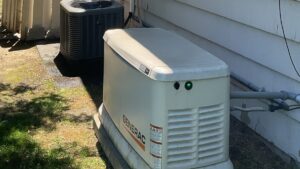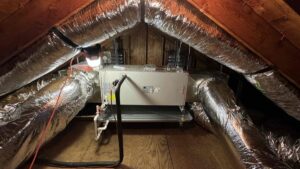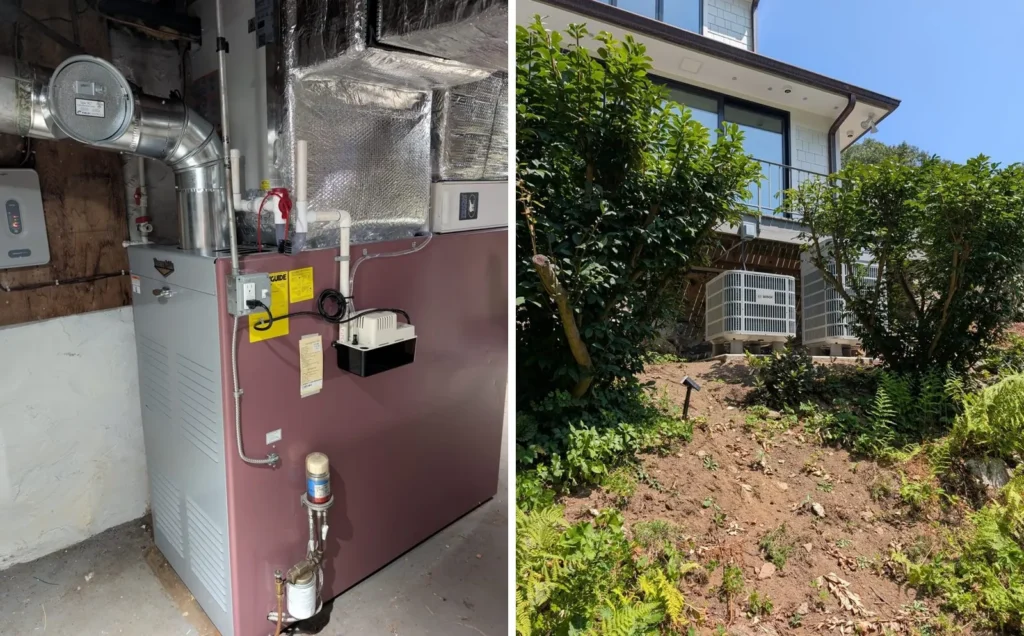
Use less oil. Stay comfortable. If you heat with oil or propane, hybrid heating adds an electric heat pump to your home while keeping a furnace or boiler for backup. The heat pump handles heating when conditions suit it and gives you air conditioning in summer. Your existing system can often stay, as long as it is in good condition and compatible with the plan.
Save up to $8,150 with available heat-pump incentives on a qualifying 5-ton system. Get a free rebate estimate from Celco to see what your home may qualify for.
For homeowners in Bridgeport and across Fairfield County, the right choice depends on your equipment, your home’s heating needs and the cost of electricity versus fuel. Here’s what to know before you switch.
How Does a Hybrid Heating System Work?
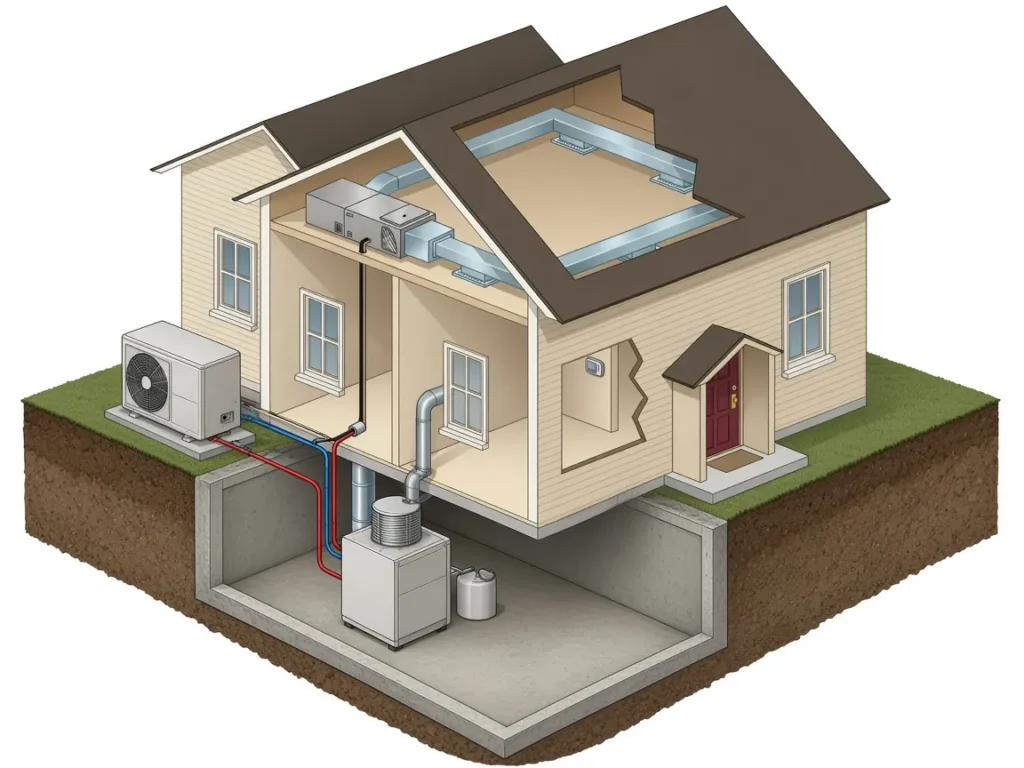
A hybrid system pairs an electric heat pump with another heating source. When the backup is a fuel-burning furnace, it is often called dual-fuel heating. Either way, your home has two ways to make heat.
A heat pump doesn’t burn fuel. It works much like an air conditioner in reverse, pulling heat from the outdoor air and moving it inside. Modern cold-climate heat pumps keep working well below freezing.
When backup heat is needed, the controls call on your furnace or boiler. That may be because the home needs more heat or because the other fuel is more economical at those settings. You don’t have to flip anything; the controls follow programmed settings.
There is no single outdoor temperature at which every system should switch; it depends on your equipment, home and system design. Most controls don’t track fuel and electric prices on their own, so the settings matter.
When Is Going Hybrid Worth Considering?
- Your central air conditioner needs replacing. A heat pump can replace an aging AC and add heating. It’s a good time to compare a standard AC replacement with a hybrid upgrade.
- Your furnace or boiler still has useful life. Keeping suitable equipment lets you add heat-pump heating without replacing everything at once.
- You want to use less oil or propane. The heat pump takes over part of the heating workload. How much fuel it displaces depends on its coverage, capacity and control settings.
- You want cooling in a home with radiators or baseboard. Ductless or properly designed ducted heat pumps can add cooling while the boiler stays for heat.
Ways to Switch to Hybrid Heating
Add a heat pump to your existing furnace
In a home with suitable ductwork, an outdoor heat pump and a matched indoor coil can work with your furnace. The furnace blower moves the air, and new controls coordinate the two heat sources. The coil, furnace, airflow and electrical supply all need to be checked together, so it isn’t always a simple outdoor-unit swap.
Replace an aging air conditioner with a heat pump
If your central AC is near the end of its life, a heat pump can take its place. You get new air conditioning for summer and efficient heat for much of the winter, with your furnace still there for the deep cold.
Add heat pumps alongside a boiler
Many older Connecticut homes heat with a boiler and radiators or baseboard, with no ductwork. Ductless mini-split units can heat and cool individual rooms or zones without adding ducts. A ducted heat pump may also work where suitable ductwork exists or can be installed.
These heat pumps heat room air. They don’t connect to your radiator or baseboard water piping, so the boiler and heat pump stay separate systems, with controls to coordinate them. Adding mini-splits alone doesn’t guarantee automatic changeover or the higher rebate.
Replace both aging systems
If your furnace and AC both need replacing, compare a complete hybrid system with other suitable options. Keeping failing equipment just to create a hybrid setup can add repair and maintenance costs.
Will Hybrid Heating Lower Your Heating Bills?
It can, but using less oil or propane is not the same as spending less overall. Your electricity use will rise when the heat pump runs. The result depends on electricity rates, fuel prices, equipment efficiency, weather and how the system is set up.
Ask for a comparison based on your recent fuel and electric bills. It should spell out the energy prices assumed, how much heating the heat pump is expected to cover and the changeover settings. A home on inexpensive natural gas may see a different result than one heated with oil or propane.
Installation cost varies with system size, ductwork, indoor-unit locations, controls and electrical work. A written proposal should list what’s included, which equipment stays and the estimated incentives separately from the project price. Both heating systems still need maintenance.
Connecticut Hybrid Heat Pump Incentives for 2026
Save up to $8,150 with available heat-pump incentives on a qualifying 5-ton system.
For eligible installations completed September 1 through December 31, 2026, Energize Connecticut’s Energy Optimization program offers $1,500 per qualifying ton, up to $10,000 per home. It is open to residential Eversource and UI electric customers. Here is how a qualifying 5-ton system adds up:
- Energize Connecticut rebate: $7,500 (5 eligible tons × $1,500)
- Separate NEHPA instant incentive: $650 on one qualifying cold-climate outdoor unit, bought through a participating distributor and passed along to you as a discount
That’s $8,150 in potential incentives. Rebate tonnage is based on the unit’s certified AHRI cooling capacity, so a model sold as “5 ton” won’t automatically earn exactly $7,500. This example is not a reason to install a larger system than your home needs.
Why the integrated control matters
If you keep your existing furnace or boiler running, the higher rebate requires a qualifying integrated control that coordinates the heat pump and backup heat. With it, Energize Connecticut pays $1,500 per ton. Without it, the project falls to the standard rate of $250 per ton. Celco includes a qualifying integrated control when you choose that option. Different rules apply if an existing heating zone is fully disconnected.
Fine print in plain terms
- Equipment must be installed by a contractor in the Energize CT Heat Pump Installer Network. Celco participates.
- Equipment, documentation and inspection requirements apply, and each program approves its own incentive.
- The $650 NEHPA incentive is a separate program from Energize Connecticut.
- Amounts can change, so confirm both programs before you commit. Energize Connecticut does not endorse any contractor.
Review Energize Connecticut’s current program requirements, then request your free hybrid heating and incentive estimate.
What to Expect When You Switch With Celco
Celco has helped Bridgeport and Fairfield County homeowners stay comfortable since 1976. A good estimate starts with your home, not with a rebate amount or the size of your old equipment. Here’s how a hybrid project typically goes.
1. A free system and incentive estimate
We review your home’s heating and cooling needs, comfort problems, existing equipment and ductwork, and which incentives may apply.
2. A right-sized design
A heat pump that’s too large or too small won’t keep you as comfortable or run as efficiently. We plan for electrical capacity, equipment locations, which rooms the heat pump serves and how backup heat works.
3. Professional installation
Our technicians install the heat pump, connect the controls to your existing or new furnace or boiler, and calibrate the system for your home.
4. Controls setup and walkthrough
The controls decide when the heat pump runs and when backup heat takes over. Your proposal should explain them, and we’ll show you how to use them at handover. If your boiler also makes your hot water, ask how that will be maintained.
5. Help with the paperwork
We help you with the Energize CT incentive paperwork. Final approval rests with each program, and some projects are selected for a post-installation inspection.
Common Questions About Switching to Hybrid Heating
Do I have to get rid of my furnace or boiler?
No. Your furnace or boiler can stay as backup heat, as long as it’s in good condition and compatible with the new system. If it’s near the end of its life, we’ll talk through replacing it as part of the project.
Do I have to remove my oil tank?
Usually not, if your oil furnace or boiler stays in service. It still needs its fuel supply. Removing a tank would be a separate decision based on your final heating plan.
Can I keep my boiler and add air conditioning?
Yes. A heat pump can add cooling and serve part or all of the heating load, depending on the design. Ductless units are one option when the home has no ducts.
Who qualifies for the heat pump incentives?
Energize CT incentives are for residential Eversource and UI electric customers whose new heat pump replaces or properly integrates with oil, propane, natural gas or electric-resistance heat. The installer must be in the Energize CT Heat Pump Installer Network.
Will the backup heat work during a power outage?
Backup heat means a second heating source, not backup power. Most furnaces and boilers still need electricity for controls, blowers or circulators. To run during an outage, they need an appropriate backup power arrangement.
Explore Hybrid Heating With Celco
Use less oil. Stay comfortable. From Bridgeport, Celco serves homeowners across Fairfield County, including Fairfield, Trumbull, Stratford, Shelton, Westport, Norwalk and Stamford, plus nearby towns such as Milford.
- Get your free rebate estimate
- Learn more about hybrid heating systems from Celco
- Schedule a service visit
- Call 203-371-0055
Celco Heating & Air Conditioning | 467 Bishop Ave, Bridgeport, CT 06610 | CT License S1-392747